Most U.S. households get their heating and cooling from central HVAC systems. These configurations rely on ductwork to distribute conditioned air evenly throughout a home. Your ducts are an integral aspect of your HVAC system. Old and damaged ducts can undermine your comfort and increase your monthly energy bills. They can also negatively impact your indoor air quality due to heightened particulate matter, gases, and moisture. Let’s explore the top five signs it’s time to replace your ducts, along with some additional considerations.
1. Your Ducts Are Older Than 15 Years
If your ducts are older than 10 to 15 years, you should consider proactively replacing them. One reason is that ductwork experiences wear and tear over time, including the deterioration of the seals between duct sections. Worn seals can impact your home’s comfort, air quality, and energy efficiency. Another reason is that duct science has evolved greatly in the several decades since yours were designed and installed. With modern software, technicians can develop ducts unique to your home that significantly lower your overall energy consumption.
When moving into a new home, you may not know how old your ducts are. In that case, you can play it safe by replacing them during your next HVAC installation. You can also schedule a duct camera inspection through which a technician can estimate their age.
2. Unexplained Rising Energy Costs
No residential HVAC ductwork system is completely airtight. Even in newly designed and constructed ducts, there will be some leakage. It’s such an important fact that the U.S. Environmental Protection Agency (EPA) accounts for it in its ENERGY STAR testing standards.
As ducts age and seals wear out, the leakage worsens. The U.S. Department of Energy (DOE) estimates that duct leakage in the average home is at least 20%. In many cases, it can be 40% or higher. That can have a dramatic effect on how much it costs to heat and cool your home. From an environmental standpoint, it also significantly increases your household’s carbon footprint.
3. Uneven Airflow Distribution
Installers configure HVAC systems to operate within a particular air pressure range. In that range, the heated and cooled air circulates evenly throughout the entire home. Leakage can cause low static pressure, while obstructions can cause high static pressure. When pressure is too high or too low, the air doesn’t disperse as expected.
This can manifest in many ways, including warm and cold spots throughout a home. In a large, multifloor house, you may experience sharp temperature differences between the levels. The insufficient airflow can also cause moisture to collect on the ground level or in the basement or crawl space.
4. Excessive Dust Throughout Your Home
A poorly maintained HVAC system and duct network can contribute to dust accumulation throughout your home. You should deep-dust your home top to bottom at least once a week. If you do that and are still seeing dust bunnies, your ducts may be the culprit. Another indication is that you’re having to replace your HVAC filters often.
Consider scheduling a duct camera inspection that enables a technician to recommend duct cleaning or other maintenance. Duct cleaning involves the use of an industrial-grade vacuum to remove all the dust and other debris. If the dust has accumulated to the point of obstructing the airflow, then it may be best to replace your ducts instead.
5. Poor Indoor Air Quality
Ducts become leaky as they age, and duct leakage isn’t a one-way process. The loss of cooled or heated air creates negative air pressure, which draws in ambient air. In summer, it can make it difficult to maintain relative humidity below 50% or even 60%. It can also introduce ambient air pollution that causes indoor pollutant concentration levels to rise.
The negative impacts from this diminished air quality can be diverse. Household members may experience more snoring and other sleep disruptions. You may deal with increased allergy attacks and heightened symptoms. Even people without allergies or asthma may experience respiratory irritation and even inflammation. Other signs you should schedule IAQ testing include:
- Lingering odors
- Persistent stale air
- Frequent coughing
- Reduced energy levels
- Headaches and body aches
Other Considerations
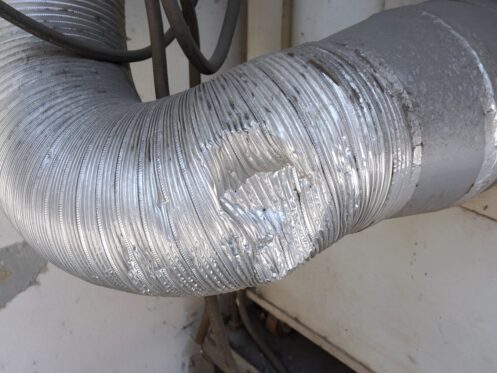
There are many other warning signs that should at least motivate you to schedule an inspection. These can include ducts that remain noisy as long as the air is blowing. Don’t ignore visible damage to your ducts, including rust, gaps, and collapsed sections. The presence of moisture, mildew, mold, or pests is potentially dangerous. You should also replace your ducts when upgrading to a high-efficiency HVAC system. Modern duct design can better accommodate zoning and other advanced features, thereby minimizing energy usage.
Why You Need Eventual Duct Replacement
While your ducts are often out of sight, out of mind, eventual duct replacement is inevitable. These are mechanical systems with finite lifespans. Their insulation, seals, joints, mounting hardware, and panels will all wear down with time. Though ducts can last 25 years, the average lifespan is 10 to 15 years due to either damage or poor maintenance. While you can continue using old, worn-out ducts, it generally isn’t advisable. You’ll experience diminished comfort, high heating and cooling costs, and heightened indoor air pollution.
When to Repair Rather Than Replace Your Ducts
An experienced HVAC technician can help you determine how best to proceed. If your ducts are younger than 15 years, it may be more cost-effective to repair them. A technician can often replace a panel or fastener here or there. If accumulation in the ducts is the issue, professional duct cleaning will often do the trick. If the problems are worn seals and panel pinholes, aerosol-based duct sealing may be able to reduce leakage to under 5%. If leakage remains higher or you have moisture or pest problems, it’s generally better to replace the ducts.
Why Spring Is an Ideal Time for Duct Replacement
Spring is often the best time to replace your ducts because you seldom have to worry about heating or cooling disruptions. Ventilation is also less of a concern, as you can rely on natural ventilation and circulation from ceiling fans. HVAC contractors tend to be more available in spring and may offer lower prices because there’s less demand for their services. Your new ducts will be ready before summer, when your energy usage will rise considerably.
Trusted HVAC Duct Solutions for the Coachella Valley
Based in Palm Desert, CA, Hermetic Heating & Air is a local HVAC company that provides a full range of HVAC services. We offer a maintenance plan that includes seasonal HVAC tune-ups and a duct inspection. Our NATE- and NCI-certified HVAC technicians provide duct cleaning, duct sealing, and duct repair services. We also perform new duct installations and replacements and offer modern ductwork design.
To schedule a service appointment or in-home consultation, call Hermetic Heating & Air today or contact us online.